Tsars Field Notes
Tsars Payments and Withdrawal Conditions
 Available in US
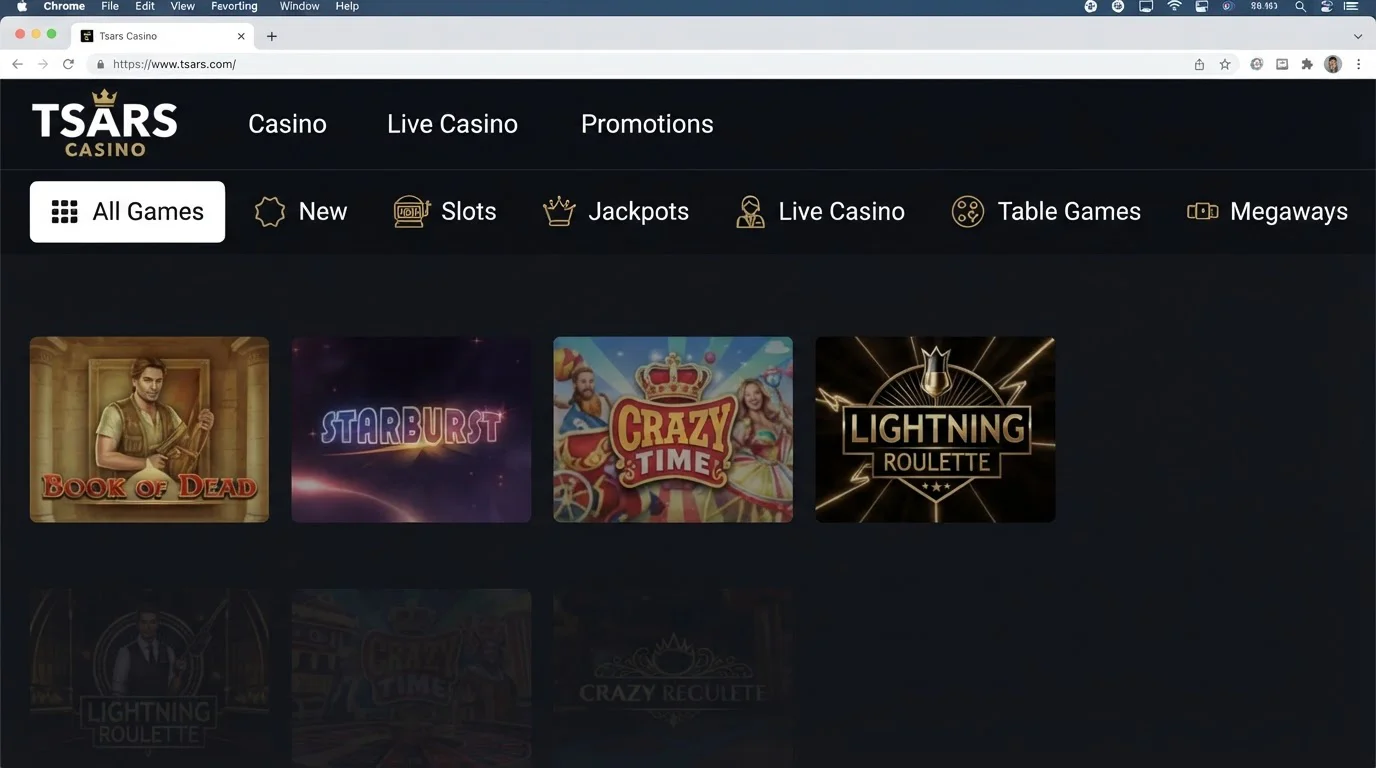
Tsars is described internationally as a hybrid casino using fiat payments alongside cryptocurrencies. Payment method lists and euro-denominated minimums can explain its general cashier structure, but they do not establish whether any prohibited online casino service is accessible to Australian customers. The useful distinction is between a listed method, an applicable account rule and the final transaction outcome.
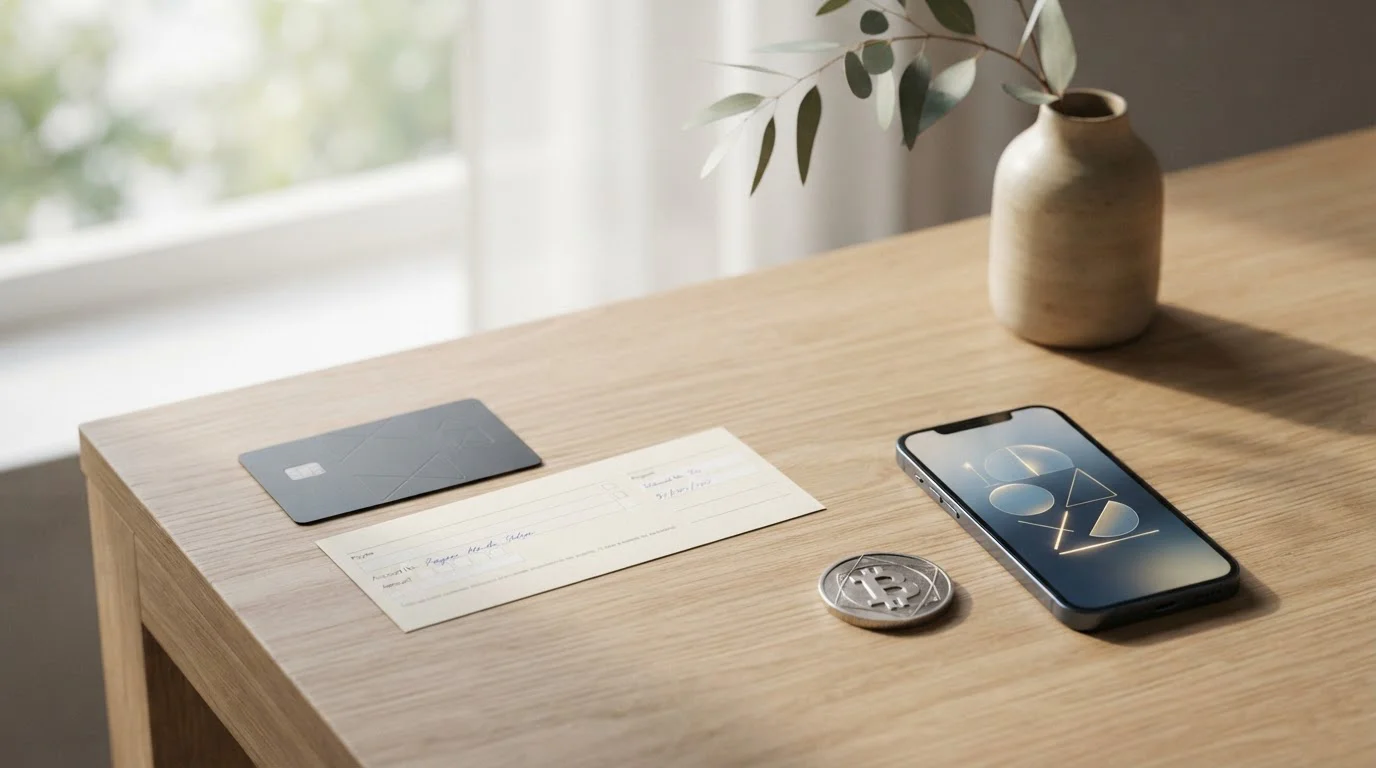
Table of Contents
- Deposit conditions and international minimums
- Transaction risk behind the cashier labels
- Withdrawal conditions, balances and conditional fees
- Crypto payments in the international Tsars catalogue
- Fiat methods and the role of financial intermediaries
- Reading a withdrawal request as a sequence of obligations
- Questions about Tsars payments
- The full cost matters more than the payment label
Deposit conditions and international minimums
Tsars combines conventional payment services with digital assets in its internationally described casino cashier. Specialist casino directories list an indicative €20 minimum deposit, although this figure is tied to general international coverage, and individual payment instruments may use their own thresholds. It should not be read as an amount offered to Australians. Different methods may also require a different currency conversion or payment-processor route.
A minimum deposit is simply the lowest amount that can pass a particular cashier rule under the relevant conditions. It is not a recommended stake, an affordability benchmark or a forecast of playtime. The number does not include any increase caused by currency conversion, a bank’s fee or a digital-asset network charge. For example, if an instrument shows a transaction fee in addition to the principal, the amount leaving the payment source can differ from the amount credited to a gaming balance.
The international catalogue includes payment cards, e-wallets, transfers and cryptocurrencies. The correct distinction is between a method appearing in general coverage and a method being available in a particular region and account. A listing of AUD as an account currency is not proof that an Australian resident can use a prohibited online-casino service.
- Minimums can depend on currency and instrument, rather than being a universal property of a casino.
- The amount debited to a payment source can differ from the amount credited to a gambling balance when fees or conversion apply.
- A deposit label does not establish withdrawal eligibility or the required payout route.
- Payment-service availability should be separated from the legal status of the underlying online-casino offering.
For readers comparing costs across payment types, the main analytical question is the full transaction rather than the headline threshold. A low entry amount is of little explanatory value if later conditions, identity checks and fees are ignored.
Transaction risk behind the cashier labels
Fiat payments and cryptocurrency transfers expose a customer to different operational risks. A card or e-wallet transaction generally depends on a financial intermediary and its dispute and authorisation procedures. A blockchain transfer may be technically final even if a destination address, selected network or denomination was entered incorrectly. That irreversibility is particularly important in a digital-asset cashier.
Cryptocurrency balances can also fluctuate in fiat value between the moment a customer acquires the asset and the moment it is converted or otherwise used. A nominally identical token amount need not represent an identical euro value at two different times. Any network fee comes from the blockchain and route used, and cannot be treated as a fixed Tsars fee merely because a coin is listed by a directory.
Consider an illustrative, non-brand-specific example: an asset worth €100 when a transfer is prepared may have a market value of €90 after a 10% price decline. That difference is market exposure, separate from any fee or casino rule. It is a scenario rather than a prediction, and it should not be mistaken for a percentage charged by Tsars.
- Identify whether the displayed number is a fiat amount or a unit quantity of a digital asset.
- Distinguish any platform fee from network charges and exchange conversion costs.
- Recognise that an irreversible transfer is not the same as a card transaction with potential intermediary review.
- Keep a clear record of the original amount, denomination, destination and transaction reference for any later enquiry.
Even where a platform shows familiar coin tickers, a name such as USDT does not specify the actual blockchain network. Token names and transfer networks are different pieces of information, and a mismatch can have serious consequences. A listed coin does not identify which transfer networks are supported for a particular transaction.
Withdrawal conditions, balances and conditional fees
The international minimum withdrawal for Tsars is €20. This is a general reference figure rather than a fixed threshold for a particular Australian account or method. A request meeting a numerical minimum may still involve account verification, payment-instrument constraints and turnover-related terms.
The most important fee distinction concerns a conditional charge. A review of Tsars terms describes circumstances in which an insufficient level of account turnover, or particular fragmented withdrawal behaviour, can trigger a charge of 20%. That is not a blanket statement that every withdrawal costs 20%. The condition matters more than treating the percentage as a universal cashier tariff.
Suppose, only as a mathematical illustration, that a conditional 20% deduction actually applied to a €100 amount under the relevant terms. The deduction would be €20 and the amount after it €80, before any other applicable adjustments. This scenario explains the scale of a conditional fee; it does not state that such a fee is routinely imposed, that it applies to Australian customers, or that a particular balance would qualify for payment.
Withdrawal caps shown by casino directories vary substantially. AskGamblers lists €5,000 per day and €15,000 per week, while another specialist profile gives materially smaller daily and weekly amounts. These are different profile figures, not a single coherent schedule. Without a method-specific, account-specific term, selecting one fixed cap would be misleading. Timing claims should be handled with the same care: a reviewer’s individual completed transaction does not establish a guaranteed withdrawal time.
The practical account sequence includes a balance request, checks against account information, possible verification documentation and a payment-provider stage. A delay during identity assessment is not identical to an operator processing delay, and neither should be represented as a fixed waiting period. Our account and verification guide explains why these stages need to be separated.
- An international minimum is a threshold, not a promise that money can be withdrawn.
- A conditional percentage should never be presented as a universal fee.
- A cap for one payment method or account level should not be applied to every withdrawal.
- Customer identification and the external payment route may affect the sequence independently of the numerical amount.
Crypto payments in the international Tsars catalogue
Tsars is generally described as supporting Bitcoin, Litecoin, Ethereum, Tether, USD Coin, Bitcoin Cash, XRP, Dogecoin, TRON, Cardano, DAI and Binance-related assets. These are entries in broader international casino profiles rather than a list of payment choices for Australian residents. Several are native assets, while others are tokens that may circulate on more than one network.
| Internationally listed category | Examples in Tsars profiles | Analytical consideration |
|---|---|---|
| Cryptocurrencies | BTC, LTC, ETH, BCH, XRP, DOGE, TRON, ADA | Exchange-rate changes and irreversible blockchain transfers can affect the final value. |
| Tokens and stablecoins | USDT, USDC, DAI | Stablecoin denomination does not remove transfer, counterparty or network risks. |
| Payment cards | Visa, Mastercard | Card-provider and currency-conversion rules depend on the issuing institution and market. |
| E-wallets | Skrill, Neteller, MiFinity, Jeton | A wallet appearing in a global catalogue does not establish local eligibility or identical fees. |
| Other fiat routes | Bank transfer, Paysafecard, Neosurf, Trustly | Some instruments can have distinct roles for funding and withdrawal. |
The international listings group methods by type, but a method named in a catalogue is not necessarily available for both deposits and withdrawals. A prepaid product, for example, may be designed primarily for adding funds rather than receiving a bank-style payout. The presence of a payment brand in a casino listing is not a complete transaction rule.
The term stablecoin also needs context. A token intended to track a currency can still be exposed to issuer, custody and technology risks. Its market value can move, and network-level mistakes can still be irreversible. Nor does the existence of a stablecoin turn the casino balance into a protected bank deposit.
Transaction records for a digital-asset payment should distinguish token quantity, fiat equivalent and network activity. Those are separate values. Neither an exchange-price example nor a market-price change can be quoted as a Tsars commission.
Fiat methods and the role of financial intermediaries
The familiar fiat names in Tsars profiles include Visa, Mastercard, Skrill, Neteller, Paysafecard, Neosurf, bank transfer, MiFinity, Jeton and Trustly. Each name refers to a different payment product with its own authorisation process. A method capable of funding an account should not automatically be treated as a method for receiving winnings.
With cards, the underlying bank and payment network can apply conversion charges, merchant restrictions and authorisation decisions. With e-wallets, the wallet provider may have separate identity checks, limits or currency options. Bank transfers introduce account-name matching and banking processing. Prepaid instruments raise a further distinction between spending a stored value and having a suitable path to receive funds.
There is also an important difference between a payment provider supporting transactions generally and that provider supporting transactions connected to prohibited online casino-style services in Australia. Familiar brand logos are not evidence of the latter. The Australian licence and law explanation explains the separate legal rules governing Australian access.
- Separate the funding method from the payout method.
- Identify whether quoted thresholds use euros, the wallet’s denomination or a converted currency.
- Treat provider-specific conversion and transfer fees independently of casino terms.
- Understand that a payment instruction may face identity and compliance checks as well as numerical limits.
This framework also explains why comparing methods solely by speed can be misleading. Processing involves stages controlled by the casino, the financial intermediary and sometimes an identity provider. An isolated fast payment is a case study, not a service-level guarantee.
Reading a withdrawal request as a sequence of obligations
A withdrawal amount is only one piece of a larger transaction. If an account displays a balance, the customer still needs to distinguish the cash balance from any funds subject to turnover requirements or other restrictions. The platform may request identity documentation, and the applicable payment route can impose independent conditions. The correct interpretation is procedural rather than predictive.
Start with the stated amount and currency. Next assess whether a conditional adjustment is described in the account terms, and whether any identity review has been requested. Then consider the role of the receiving instrument. For crypto, token denomination, market movement and irreversible transfer mechanics remain separate from the casino’s balance figure.
For an illustrative €100 amount, a €20 international reference minimum is satisfied arithmetically, but that arithmetic alone does not establish payment permission, fee treatment or a completion date. The home-page withdrawal checker illustrates only the difference from an international reference threshold, not a live cashier balance or an eligibility decision.
- Amount and denomination: what number is being compared?
- Turnover and charges: does a specific condition apply to the described situation?
- Identity: does the transaction require account information or documents?
- Receiving method: is the instrument appropriate for a payout, and what external costs could arise?
- Outcome: avoid converting any single stage into a guaranteed payment time.
A risk-centred reading of the terms is more useful than a headline claim of fast withdrawals. The most consequential variables are conditions that actually apply to the individual transaction; another reviewer’s experience cannot replace them.
Questions about Tsars payments
Which payment methods are associated with Tsars?
International casino profiles list bank cards, e-wallets, transfers and several cryptocurrencies, including Bitcoin, Ethereum, USDT and USDC. These are not payment options offered to Australian residents.
What minimum withdrawal is reported for Tsars?
An international casino profile gives €20 as a minimum withdrawal reference. The method and account context remain relevant; the figure is not an Australian cashier offer.
Does Tsars apply a 20% charge to every withdrawal?
No. The 20% figure describes a conditional charge associated with particular turnover or withdrawal circumstances, not a universal withdrawal fee.
Does the presence of USDT identify its transfer network?
No. The coin or token ticker does not by itself identify the blockchain network. A supported coin and a specific transfer network are different details.
Does a €20 threshold guarantee that a withdrawal will complete?
No. A threshold is only one condition. Account verification, applicable terms and the receiving payment route can affect a transaction.
The full cost matters more than the payment label
Tsars’ international cashier spans fiat and cryptocurrencies, with an indicative €20 minimum and some conditional withdrawal charges. A payment method name or minimum amount is only the beginning of the analysis: actual costs depend on account terms, identity checks, currencies and intermediaries. Cryptocurrency adds market volatility and potentially irreversible transfers, while the general international listings do not establish Australian availability.
Read next
Created by the ”Tsars” editorial team.