Tsars Field Notes
Tsars Casino Games and Software Providers
 Available in US
Tsars brings together slots, progressive jackpots, hosted live tables and other digital formats through an internationally described catalogue. Providers range from traditional slot studios to live-dealer specialists. Understanding the rules, the pace of paid decisions and the distinction between theoretical return and short-session experience matters more than a headline game count.

Live tables and game-show formats
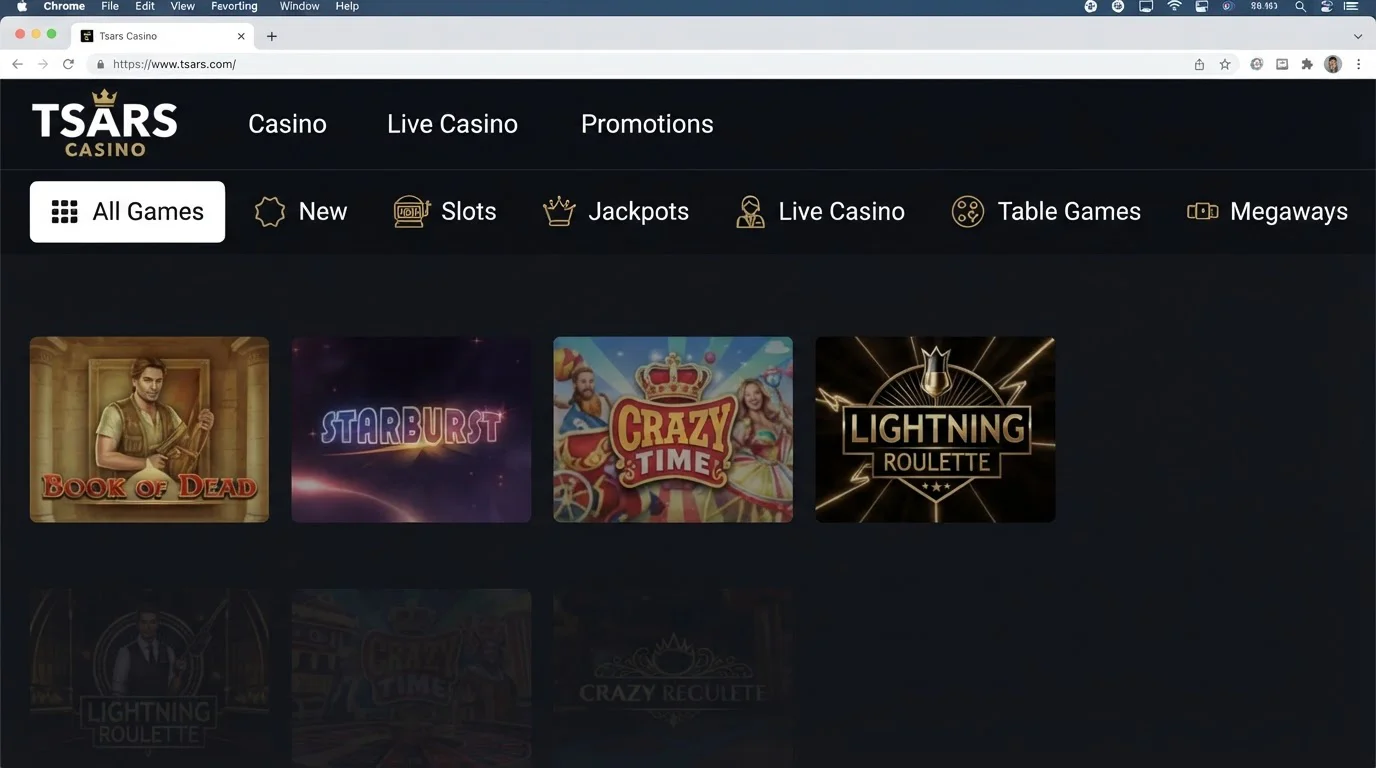
Tsars lists a live-casino offering alongside its digital slot catalogue. The live segment includes roulette, blackjack and baccarat, as well as hosted entertainment formats. A live game transmits a dealer or presenter from a studio and combines that picture with betting controls. The stream changes presentation and pacing; it does not make a gambling outcome predictable. Every round retains its own probability structure and rules.
Roulette follows a wheel and a defined set of outcomes. The result of a single spin is independent of the visual drama around it. A record of recent colours or numbers describes past outcomes, not a mechanism for forecasting the next one. Table variants can also have different layouts and special rules, so the title alone is a poor substitute for reading the underlying paytable and conditions.
Blackjack introduces decisions about drawing, standing and sometimes splitting or doubling. Those decisions affect the mathematical profile of a hand under a particular rule set. A branded live table may look familiar while differing in dealer rules, number of decks or side bets. Side bets are separate wagers with their own probabilities; treating them as a harmless extension of the base hand can distort the cost of a session.
Baccarat is more procedural: after stakes are placed, the drawing rules govern the hand. Banker, player and tie bets are different propositions. A compact interface makes placing them easy, but a short round can encourage repeated exposure. Sic bo, also listed within the broader games range, operates with dice outcomes and multiple bet types, each requiring its own understanding of probability.
Live game shows add presenters, prize wheels or audiovisual sequences. Their entertainment format can make time feel less connected to the number of wagers. The relevant comparison is how often a financial commitment is made, how the game settles the outcome, and whether optional multipliers or side outcomes change the wager. This framing works across roulette, dice and studio-hosted formats without claiming that any particular session is safer.
A game provider supplies software and usually the rules of its titles. That is distinct from a casino handling accounts, balances and withdrawals. Tsars is associated with Evolution and Ezugi for live content, while other named studios contribute different forms of catalogue material. For the relationship between game selection and account checks, see the account and identity guide.
- Roulette: examine the wheel layout, bet types and any special-rule variation before interpreting a displayed result.
- Blackjack: separate the base-hand rules from insurance, side bets and additional wagering options.
- Baccarat: distinguish banker, player and tie markets; identical table branding need not imply identical payout choices.
- Live shows: count financial decisions across a session rather than using programme length as a proxy for expenditure.
Software providers and catalogue breadth
The international Tsars catalogue is associated with software from Pragmatic Play, Play’n GO, NetEnt, Nolimit City, Evolution, Ezugi, Relax Gaming, Red Tiger and Wazdan. These names cover different production styles: traditional reels, feature-heavy slots, table games and streamed studio formats. The range is large enough to span thousands of titles, but a rolling total would hide changes in availability, game versions and distribution agreements.
Software companies and the casino have different responsibilities. The studio develops the underlying game and usually sets out its rules, paytable and mathematical model. The casino organises the account experience, navigation and balance management. A familiar provider mark is useful for locating a game family; it is not evidence of the rules for a particular title or of the financial result of playing it.
Provider catalogues are commonly filtered by category, feature or device compatibility. These filters solve a discovery problem, not a risk problem. Finding ten games of the same studio can expose someone to different levels of complexity, different return models and different win distributions. Comparisons become meaningful only at the title level. A label such as “high volatility” describes an intended distribution of outcomes; it is not a prediction for the next session.
The distinctions also matter when a game has several versions. A version can change the cost of optional features, the stake grid or the pace of autoplay-like functionality without changing the broad game family. A specific game’s help panel is therefore more useful than the claim that a provider has a fixed profile across its entire portfolio.
The breadth of this catalogue also reflects the way games are licensed and distributed. A studio may have a recognised name and still supply different menus in different markets. General international Tsars provider lists describe the product, not a playable Australian menu. Any reader comparing game libraries should avoid turning a directory entry into a claim about regional access.
It is possible to compare game formats without treating the quantity of available titles as a measure of quality. A smaller set with transparent rules may be easier to understand than an enormous list of near-identical entries. Number of titles, number of providers and number of categories measure different things and should not be interchanged.
- Pragmatic Play, Play’n GO and NetEnt contribute recognisable slot-game families.
- Nolimit City, Relax Gaming, Red Tiger and Wazdan add further slot styles and feature structures.
- Evolution and Ezugi are associated with live-dealer experiences.
- A game’s title-level rules carry more information than a brand-level provider count.
Slot categories, jackpots and session exposure
Slots form a major part of Tsars’ general product offering. The term covers classic reel layouts, video slots with multiple paylines or ways to win, and bonus-feature designs with unusual symbol mechanics. Progressive jackpots are another listed category. Their headline prize represents the maximum of a particular structure, not the typical result of a session or an amount that a player can expect to obtain.
For every slot, the important documents are the game rules and paytable. They explain how a unit stake is constructed, which symbols pay, how features trigger and how any optional side feature changes the commitment. A setting that looks like a small bet may be multiplied by lines or by a feature purchase mechanism, depending on the title. A game interface should be interpreted as a contract for an individual wager, not as a promise of returns.
Return to player, or RTP, describes a theoretical long-run ratio over a very large number of plays for a particular version. It does not mean an individual session returns that percentage. The difference between a theoretical average and a short result can be enormous, especially in a volatile game. Tsars-wide RTP cannot responsibly be assigned from the catalogue alone; specific titles must be understood separately.
Volatility describes the spread and frequency of outcomes, not the possibility of a guaranteed positive run. A title may pay smaller sums comparatively often or concentrate prizes into rarer events. Two games can have similar theoretical RTP and very different short-session experiences. The pace of clicking also matters: the amount risked is the stake per decision multiplied by the number of decisions, regardless of whether the display is a dramatic animation or a simple reel spin.
As a purely hypothetical arithmetic example, twenty paid rounds at a stake of one unit create twenty units of total wagering exposure. That is a sum of stakes, not a forecast of the final balance; returned prizes can be recycled and an apparent account balance can mask the cumulative amount put at risk. The simple product of stake and number of rounds is useful for understanding how quickly repetitive play adds commitments.
Jackpots add a further complication. A displayed jackpot amount does not tell a player the chance of winning it, the contribution required or whether eligibility is restricted by stake or version. Bigger numbers have stronger visual impact than small probabilities, which is why a clear reading of rules and session spending is more valuable than the prize panel itself.
Payment design is part of the same practical picture. If a balance is funded with cryptocurrency, changes in exchange value and possible transfer fees can affect the real-world cost independently of any game result. The Tsars payments analysis separates those transaction risks from the mathematical cost of wagers.
- A stake is committed on each paid round, even when the interface calls it a spin or feature.
- RTP is a long-run mathematical property of a game version, not a short-run promise.
- Volatility and progressive prizes change outcome distribution, not the certainty of an individual result.
- Time, number of rounds and size of stake together help describe session exposure.
Demo play and differences from a cash balance
An AskGamblers review of Tsars observed a play-for-fun or demo mode. Demo access allows someone to inspect the structure of a game without staking a real-money balance. It can be useful for locating the paytable, understanding controls, and seeing how the feature sequence is presented. That practical role should not be confused with testing whether a paid session will produce similar outcomes.
A demo session demonstrates how interface elements respond. It is not a reliable simulation of how often particular rare outcomes will occur in a small real-money sample. Short experiences are especially deceptive: a dramatic feature in a handful of demo rounds is memorable, but the observation does not establish a stable frequency or a future return. As with paid play, random outcomes cannot be inferred from a streak.
Demo balances also change the psychological frame. A large fictional number can encourage very high fictional stakes, making the game appear comfortable at a scale unrelated to a real budget. Some controls may display different reminders or balance messages depending on the mode. For this reason, understanding the rules and controls is a more defensible objective of demo interaction than judging expected profit.
Demo access can also differ by title. One studio may make a trial version straightforward to reach, while another reserves particular features for a different context. General evidence that Tsars offered demonstration play should not be treated as a promise that every listed game has the same option. The useful takeaway is that the observed feature provides a way to study mechanics without using a cash balance.
Whether the interface is demo or paid, attention should still be given to visual accessibility. Small symbols, dense tables or quickly advancing feature messages can make it harder to understand what happened. On a phone, that difficulty can be magnified by the available screen space. The mobile experience guide explores the presentation and control issues separately.
The safest interpretation of the games library is as a mix of different rule systems. Slots, live tables and game shows should not be placed on one scale of “easy winnings”. Their stakes, distributions and pace need individual treatment. Category names and provider brands are starting points for understanding the product; the wager and its rules determine the financial exposure.
- Read a game’s help panel before interpreting a payline or multipliers.
- Use demo displays to understand menus and symbols, not to project a financial return.
- Recognise that cash balance and simulated balance create different consequences.
- Keep the total amount risked separate from the visual duration of a round.
Questions about Tsars games
What types of games does Tsars list?
Its international catalogue includes slots, progressive jackpots, live roulette, blackjack, baccarat, sic bo, bingo, scratchcards and game-show formats.
Which software providers appear in the catalogue?
Pragmatic Play, Play’n GO, NetEnt, Nolimit City, Evolution, Ezugi, Relax Gaming, Red Tiger and Wazdan are among the listed studios.
Can a demo session predict real-money results?
No. A demo helps explain controls and game rules, but a short run of random outcomes does not predict a future paid session.
What does RTP tell a player?
RTP is a theoretical long-run proportion for a particular game version. It does not predict the result of one session or guarantee any return.
Game variety makes rule-by-rule comparison essential
Tsars’ international game offering spans several wager structures and named software studios. A useful comparison starts with the paytable, stake and number of paid decisions, then treats provider variety and feature-rich visuals as catalogue characteristics rather than evidence of a likely financial outcome.
Read next
- Home overview
- Mobile experience
- Account checks
Written by the editors at Tsars.